Permanent Magnet Generator - Stamford PMG System


For certain applications, permanent magnets can provide the magnetic field of a generator. The rotor structure can provided by a doughnut of magnetic iron with magnets fixed on its surface.
A magnetic flux density can be provided using by a radial depth of various types of magnetic materials comprising of neodymium-boron-iron or samarium-cobalt of less than 10 millimetres in the air gap corresponding to that produced with field windings.
A considerable reduction in air-gap flux density can be achieved by using magnet materials such as ferrite. Although this causes a corresponding increase in dimensions of the generator.
Permanent-magnet generators are simple because no system for the provision of field current is required. Although they are very dependable but they do not carry any means for assuring the output voltage.
A true example of application is with a wind turbine where the generator output of variable voltage and frequency is supplied to a power system through an electronic frequency converter.


For a series of relevant videos, please visit http://www.youtube.com/watch?v=tKisECPf264&playnext=1&list=PLE07CEBB26FD4041E

Video Tutorials for using Car Alternator in Wind Turbines


Most of their time wind generators rotate at low rotations. Car alternators would not generate anything at lower speed of wind turbines. Therefore, using a car alternator in wind generator is really a poor option.
  • The efficiency of alternator would never reach more than about 60 %. The bearings are very small and can not support large blades reliably (about 1.5 meters diameter). The car alternator has been designed as lightweight and robust being its functioning at very high rpm.
  • Although a small blade can be used to make the alternator spin at high rpm. But smaller blades would catch less wind. You would need a high wind speed to obtain necessary speed of rotation.
  • Gears with pulleys or other methods can be used to boost rpm. But a lot of power is wasted through friction. This would result in additional cost, further losses, added unreliability, and a horribly and awkwardly made project.
  • There is another possibility of rewinding the alternator to run at lower speed. But this also means that there would be more turns of thin wire in each coil. In this method cut-in rotations are decreased, but losses in the coils are also increased, thus you would get decreased power output and further reducing the already low efficiency.
  • Car or truck alternator is an electromagnetic device. It means that separate power is required by the alternator to make the magnetic field for its electromagnetic coils internally through brushes and slip rings.


Scientists make solar cells with cheap metal oxide

Scientists make solar cells with cheap metal oxide
University of Oxford scientists have discovered a way to make solar cells from a metal oxide found in toothpaste.
A team led by Dr Henry Snaith at the physics department combined the oxide with a thin dye printed on to glass to turn the sun's energy into electricity.
The glass can be produced in a range of different transparent colours for use in windows and cladding buildings.
"It opens up a lot of versatility and a lot of possibilities for building design," said Dr Snaith.
Because the manufacturing process uses abundant, non-toxic materials the carbon footprint is considerably smaller than rival technologies.
Ollie Bennett, from MiPower, a company that specialises in installing solar panels, said he had not seen anything like the new cells on the market.
"I think this is a really good idea and it could be a forerunner," he said.
Dr Snaith said the team had still had some work to do on improving its efficiency.
"But coupled with our extremely low cost of manufacture and processing and the ongoing research effort to improve the overall performance of the device, we think it's only a short while till our performance will be competitive," he said.

Make Solar cells by waste vegetation

Remote communities could eventually make their own solar cells using waste vegetation, thanks to a design developed by researchers in Switzerland and the United States.

The technology is inspired by photosynthesis. In plant cells, sunlight separates electrical charges with almost 100 per cent efficiency.

Electrical charges must also be separated to create currents in solar cells. For the past decade, researchers have attempted to make solar cells by extracting some of the molecules responsible for photosynthesis — known as photosystem-I (PS-I) — from plants to produce an electric current when exposed to light.

Earlier devices failed to generate much electricity. But a team led by Andreas Mershin at Massachusetts Institute of Technology, United States, now claims to have found a solution so simple it can be replicated in any lab.

They have found a way of exposing more of the cell to the sun by creating a three-dimensional miniature ‘forest’ of zinc oxide nanowires and titanium dioxide sponges on a layer of glass, coated with PS-I, that absorbs any sunlight filtering down onto the surface from above and turns it into electricity. Previous versions of the cell, by other researchers, were flat.

The new experimental solar cell converts 0.1 per cent of incoming sunlight’s energy to electricity. This is still short of the 1.0 per cent conversion rate it needs to be practical — but 10,000 times more than any previous cell of this sort.

Mershin hopes that, in a few years, rural communities would be able to mix waste vegetation — even grass clippings — into a bag containing the zinc and titanium, and paint the mixture onto their roofs to start generating electricity.

“All the major discoveries have now been made,” he told SciDev.Net.

“We hope that other groups around the world can now replicate what we’ve done and optimise the techniques — and that is why we have published our findings in an open-access journal.”

Devens Gust, director of the Arizona State University Center for Bio-Inspired Solar Fuel Production in the United States, said: “The advance here is devising a relatively simple method for preparing photovoltaic cells with significant light absorption for laboratory study using this material.”

But Frederik Krebs of the Risø National Laboratory for Sustainable Energy in Denmark, who has experience of deploying organic solar cells in Africa, is more cautious.

“There is a very long way from a laboratory vision to a real live application to real live people having no knowledge of (the technology),” he said. He is also concerned that the sun could damage the organic material .

http://dawn.com/2012/02/19/idea-could-lead-to-cheap-solar-cells-using-plant-waste/

Solar panel made with ion cannon is cheap enough to challenge fossil fuels

Twin Creeks, a solar power startup that emerged from hiding today, has developed a way of creating photovoltaic cells that are half the price of today’s cheapest cells, and thus within reach of challenging the fossil fuel hegemony. The best bit: Twin Creeks’ photovoltaic cells are created using a hydrogen ion particle accelerator.

As it stands, almost every solar panel is made by slicing a 200-micrometer-thick (0.2mm) wafer from a block of crystalline silicon. You then add some electrodes, cover it in protective glass, and leave it in a sunny area to generate electricity through the photovoltaic effect (when photons hit the silicon, it excites the electrons and generates a charge). There are two problems with this approach: Much in the same way that sawdust is produced when you slice wood, almost half of the silicon block is wasted when it’s cut into 200-micrometer slices; and second, the panels would still function just as well if they were thinner than 200 micrometers, but silicon is brittle and prone to cracking if it’s too thin.

This is where Twin Creeks’ ion cannon, dubbed Hyperion, comes into play. If you look at the picture above, 3-millimeter-thick silicon wafers are placed around the outside edge of the big, spoked wheel. A particle accelerator bombards these wafers with hydrogen ions, and with exacting control of the voltage of the accelerator, the hydrogen ions accumulate precisely 20 micrometers from the surface of each wafer. A robotic arm then transports the wafers to a furnace where the ions expand into hydrogen gas, which cause the 20-micrometer-thick layer to shear off. A metal backing is applied to make it less fragile (and highly flexible, as you see on the right), and the remaining silicon wafer is taken back to the particle accelerator for another dose of ions. At a tenth of the thickness and with considerably less wastage, it’s easy to see how Twin Creeks can halve the cost of solar cells.

According to Technology Review, ion beams have been considered before, but particle accelerators were simply too expensive to be commercially viable. This is the flip side of Twin Creeks’ innovation: It had to make its own particle accelerator which is “10 times more powerful” (100mA at 1 MeV) than anything on the market today.

Solar cell will boost 400 percent by HyperSolar concentrator

Solar cell will boost 400 percent by HyperSolar concentrator
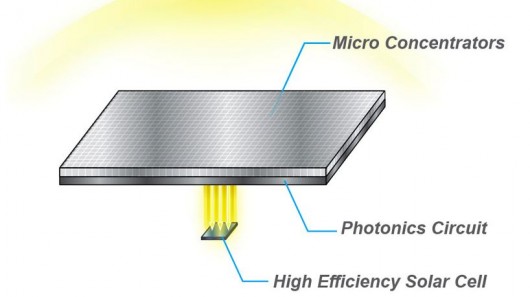
HyperSolar is developing a breakthrough technology that magnifies the power of the sun to significantly increase the power output of solar cells.

Using innovative photonics and low-cost manufacturing processes, HyperSolar is developing the world's first thin and flat solar concentrator for standard solar cells. Applied on top of solar cells, the low-cost HyperSolar concentrator can increase solar cell power output by as much as 400%.

By adding the HyperSolar concentrator, manufacturers can use significantly fewer solar cells in the production of solar panels and dramatically reduce the cost per watt of solar electricity.

HyperSolar is developing a breakthrough technology to produce renewable hydrogen and natural gas using sunlight, water and carbon dioxide. These renewable gases can be used as direct replacements for traditional hydrogen and natural gas to power the world, without drilling or fracking, while mitigating CO2 emissions.

NanoPower solar window production

Octillion announces NanoPower solar window production breakthrough